Loading article

Integrating financial services into a SaaS platform, marketplace, ERP or e-commerce platform is not simply a matter of connecting a payment API. Behind a seemingly seamless journey sit three essential layers: security, compliance and monitoring.
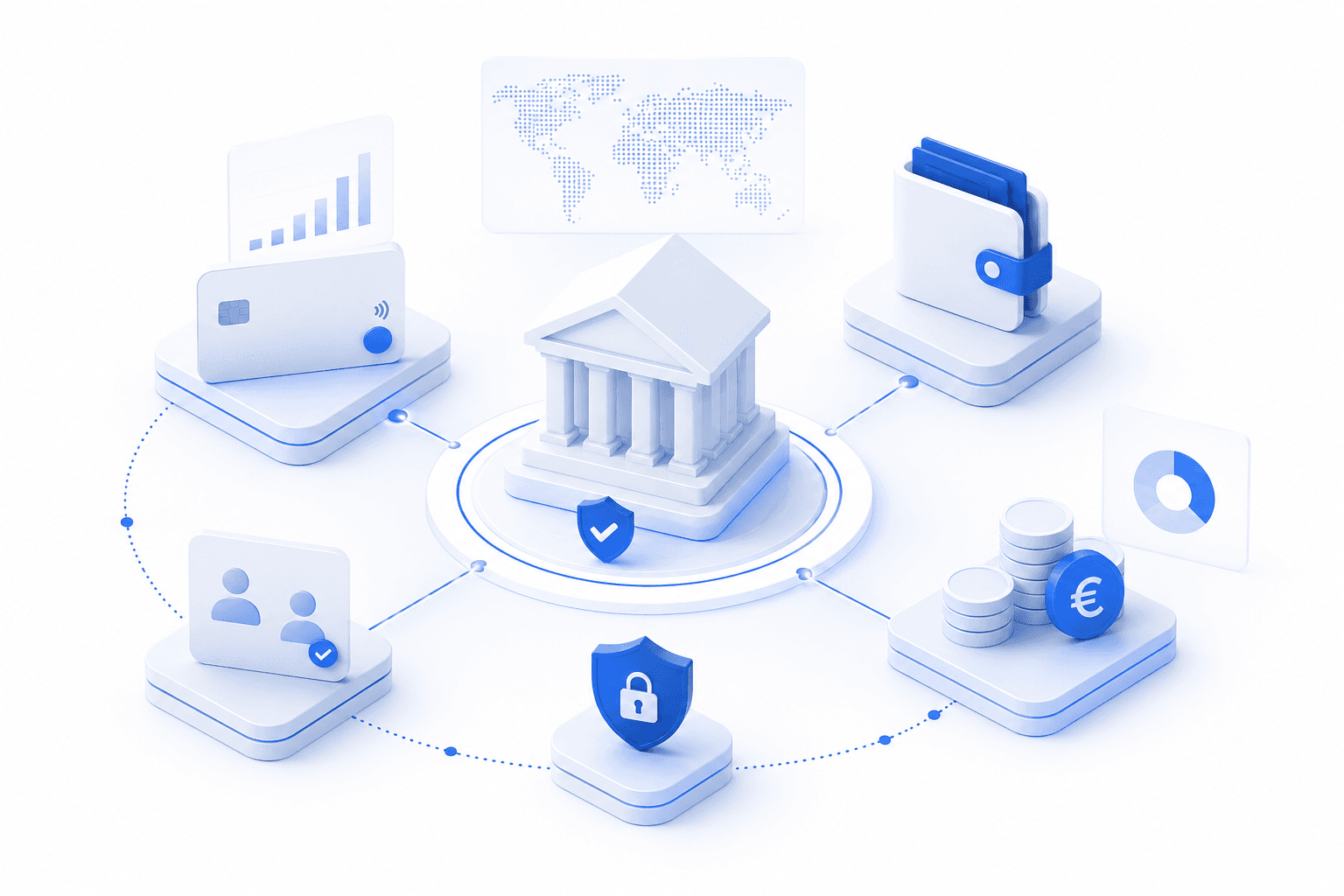
Security protects systems, data, access rights and transactions.
Compliance defines responsibilities, controls, regulatory obligations and KYC or KYB journeys where required.
Monitoring makes it possible to track flows, detect anomalies, handle incidents, manage statuses and maintain operational quality.
These three layers are often invisible to the end user. Yet they determine the reliability of the service, the level of trust in the platform and the ability to scale.
For SaaS providers, marketplaces and business platforms, the challenge is therefore not only to integrate payment. The challenge is to integrate a complete, robust and understandable financial journey without making the user experience heavier.
The API is essential. It connects financial functions to an existing product: creating a payment account, issuing an IBAN, tracking a transaction status, triggering a transfer, receiving a notification, generating reporting or reconciling a payment.
But an API alone does not make a financial infrastructure.
An integrated financial journey must answer much broader questions:
who the end user is;
who initiates the payment;
who receives the funds;
which status should be displayed;
which data must be collected;
which checks are required;
who handles errors;
who monitors anomalies;
how data is protected;
how funds and flows are tracked;
what happens in the event of an incident;
which responsibilities are borne by each party.
A platform that integrates payments without addressing these issues risks creating a fragile experience. It may appear fluid at launch, but become difficult to operate as volumes grow, use cases diversify or exceptions multiply.
Embedded finance must not be viewed solely as a technical building block. It must be designed as an architecture of trust.
An integrated financial journey rests on three complementary layers.
The first is security. Its purpose is to protect access, data, systems, payment instruments and operations.
The second is compliance. Its purpose is to ensure that the services offered, the users involved, the flows processed and the responsibilities of each party are consistent with the applicable framework.
The third is monitoring. Its purpose is to track operations continuously, detect anomalies, handle exceptions and manage service quality.
These three layers must be designed together.
A platform may have strong technical security but a poorly integrated compliance journey. It may have a satisfactory KYC or KYB onboarding process, but insufficient operational monitoring. It may track flows, but lack sufficiently precise alerts when anomalies occur.
It is the combination of these three layers that creates a reliable financial journey.
Security is the first level of trust.
In an integrated financial journey, it is not limited to servers or encryption. It covers the entire chain: user access, authentication, rights management, data protection, transaction integrity, API security, detection of suspicious behavior, event logging and system resilience.
For a SaaS platform, marketplace or digital platform, security must be designed from the very beginning of the journey.
Who can access the financial feature?
Who can initiate a payment?
Who can view an IBAN?
Who can modify beneficiary information?
Who can trigger a payout?
Who can export payment data?
Which events are logged?
Which controls are triggered in the event of unusual behavior?
These questions are structural. They prevent integrated payment from becoming a vulnerability within the product.
The first weakness in a financial journey is not always located in the infrastructure. It can come from access management.
A company administrator, employee, accountant, seller, service provider or internal support agent should not necessarily have the same rights.
A platform must therefore provide granular role and permission management:
viewing statuses;
initiating a payment;
validating a payout;
modifying a beneficiary;
accessing supporting documents;
exporting data;
managing alerts;
administering the account.
This rights management is a product issue. It must be understandable for the end user, configurable according to needs and consistent with business use cases.
A secure financial journey is one in which every sensitive action is assigned to the right level of authorization.
An integrated financial journey often handles sensitive or critical data: identity, company information, beneficial owners, bank details, payment statuses, supporting documents, transaction histories, KYC or KYB documents, billing information and reconciliation data.
Protecting this data is a trust issue.
It is not enough to collect the required information. A platform must also know why it is collected, how long it is retained, who can access it, how it is secured, how it is shared and how the rights of the individuals concerned are respected.
In a B2B environment, financial data becomes operational data. It feeds the product, reporting, accounting, support and sometimes the customer relationship.
This is why security must be designed as a cross-functional layer, not as a final audit step.
APIs play a central role in embedded finance. They connect business software to financial infrastructure.
But the more central the API becomes, the more secure it must be.
Key areas of attention include:
authentication of API calls;
restricted access by environment;
management of keys and secrets;
permission controls;
monitoring of unusual volumes;
validation of received data;
protection of webhooks;
event logging;
management of errors and repeated attempts.
Webhooks in particular are essential for synchronizing payment statuses with business software. They must be reliable, secure and properly processed on the platform side.
A status that is not received, misinterpreted or incorrectly displayed can create significant operational errors: an invoice marked as paid when it is not, a payout triggered too early, an unnecessary reminder sent to a customer or a support team contacted without need.
API security is therefore directly linked to product quality.
Compliance is the second layer of an integrated financial journey.
It should not be treated as an obstacle external to the product. It must be integrated into the journey in a clear, progressive and proportionate way.
In some cases, a platform will need to collect information about its users, verify their identity, understand their business activity, identify beneficial owners, analyze certain flows or document operations.
For a SaaS platform or marketplace, the challenge is to integrate these obligations without damaging conversion.
A compliant but incomprehensible journey can cause the user to abandon the process.
A fluid but insufficiently controlled journey can create regulatory risk.
The right model combines both: clarity, proportionality and traceability.
KYC, for Know Your Customer, and KYB, for Know Your Business, are often perceived as barriers to onboarding.
That is true when they are poorly integrated.
A user who does not understand why a document, director, supporting evidence or business activity information is being requested may perceive the process as intrusive or unnecessary.
Conversely, a well-designed journey clearly explains:
which information is required;
why it is requested;
when it becomes necessary;
the status of the file;
what is missing;
how long processing may take;
which features are available or blocked.
For a SaaS provider, the challenge is to make compliance readable. The journey must not become a black box.
Many platforms fear that compliance will damage conversion. This is a real risk, but not an inevitability.
Compliance can be integrated progressively.
For example, a platform can allow a user to discover the feature, understand the value proposition, prepare the required information, and then complete the checks when the financial use becomes effective.
This progressive approach avoids asking for too much information too early, before the use case actually justifies it.
Compliance then becomes part of the product journey, not an administrative wall.
For SaaS platforms, this is a strategic point: a well-designed financial journey can strengthen trust while preserving adoption.
In an integrated financial journey, compliance is not limited to document collection.
Responsibilities must also be clarified.
Who contracts with the end user?
Who provides the payment service?
Who performs the checks?
Who stores the data?
Who handles requests for additional information?
Who responds in the event of a complaint?
Who monitors the flows?
Who decides whether a service should be blocked or limited?
These questions must be addressed before launch. They must be consistent with the contractual model, the user journey, commercial documentation and operational processes.
This is particularly important in API integration, white-label, grey-label or payment institution agent models.
Clear responsibilities protect all parties: the end user, the platform, the financial infrastructure and the partners.
The third layer is often the least visible, but it is decisive: monitoring.
An integrated financial journey does not end when a payment is initiated.
Statuses must be tracked, exceptions handled, anomalies detected, rejections managed, atypical flows investigated, reports produced, support requests answered and service continuity maintained.
Without monitoring, a platform can quickly end up with operations that are difficult to explain:
pending payments;
rejected transfers;
inconsistent statuses;
unverified beneficiaries;
blocked payouts;
unreconciled refunds;
amount anomalies;
mapping errors between invoice and payment;
support requests without actionable answers.
Monitoring is therefore the link between the product promise and operational reality.
Statuses are at the heart of an integrated financial journey.
A user wants to know whether an operation has been initiated, is pending, validated, rejected, expired, cancelled, refunded or requires review.
These statuses must be consistent between the financial infrastructure and the SaaS interface.
Poor synchronization can create confusion. An invoice may appear as paid while the payment is still being processed. A seller may wait for a payout that has already been rejected. A support team may not have the information it needs to respond.
Status tracking must therefore be treated as a product feature in its own right.
Processing transactions is not enough. Their state must be made understandable.
Every financial journey generates exceptions.
The question is not whether they will occur, but how they will be detected, prioritized and handled.
An anomaly may be technical, operational, behavioral or documentary:
repeated attempt;
unusual amount;
inconsistency between beneficiary and activity;
payment failure;
change to sensitive details;
atypical flow;
incomplete file;
expired document;
blocked status;
reconciliation error.
These events must be visible. They must trigger alerts or appropriate handling processes.
A strong monitoring system does not merely record events. It helps teams take action.
Fraud is a central issue in financial journeys.
However, fraud prevention should not translate into an unnecessarily heavy experience for all users.
The right approach is to combine several elements:
detection rules;
behavioral signals;
enhanced controls on certain operations;
alerts on sensitive changes;
limits on certain actions in case of doubt;
manual review when necessary;
traceability of decisions.
The objective is to protect the system without unnecessarily blocking legitimate use cases.
For a SaaS platform, this requires finding the right balance between security, fluidity and trust.
Security, compliance and monitoring are not only constraints. They can become value drivers.
A SaaS platform that integrates financial services reliably becomes more central in its users’ daily operations.
It no longer merely displays data. It enables action.
It no longer merely produces an invoice. It enables the user to track its payment.
It no longer merely records an order. It connects order, collection, payout and reporting.
It no longer merely provides a dashboard. It becomes a financial control point.
This centrality increases depth of use.
The more users perform critical operations within the software, the more structural the software becomes. Retention is then not based on artificial lock-in, but on genuine utility: fewer manual tasks, fewer errors, more visibility and more trust.
This is one of the major stakes of embedded finance for SaaS providers and platforms.
The three layers of security, compliance and monitoring are particularly important in several contexts.
Invoicing software that integrates collection must secure access to payment information, verify users when required, synchronize statuses and enable reconciliation.
The value is strong: the software becomes the natural point of reference between invoice, payment and reporting.
A marketplace often manages several parties: buyers, sellers, service providers, commissions, payouts and refunds.
In this context, flow monitoring is critical. A poorly managed status can affect several users at the same time.
Freelance, intermediation or professional services platforms often manage payments between clients and service providers.
Access security, company KYB, payout tracking and exception handling quickly become operational issues.
An ERP or vertical software solution may integrate payment functions directly linked to orders, interventions, files, contracts or subscriptions.
The challenge is to connect business data and financial data without creating a break in the journey.
Hybrid platforms that sometimes connect euros, accounts, wallets or digital assets must pay particular attention to journey clarity, responsibilities and flow monitoring.
Technical complexity must never be transferred to the end user.
TRACTIAL can support platforms in designing integrated financial journeys based on a clear articulation between security, compliance and monitoring.
For a SaaS platform, marketplace, ERP or e-commerce platform, the objective is to start from real use cases: collection, payout, status tracking, reconciliation, payment account, integrated IBAN, user onboarding, reporting or flow monitoring.
TRACTIAL can review with platforms:
the nature of financial flows;
the role of users;
current friction points;
API integration needs;
KYC or KYB prerequisites;
security rules to be planned;
statuses to be displayed;
anomalies to be monitored;
success indicators;
the scope of a pilot.
For SaaS providers, the benefit is clear: integrating financial functions without carrying alone the full technical, regulatory and operational complexity.
The value does not come from payment alone. It comes from the ability to offer a reliable, understandable and operational journey within the existing product.
In business software, trust is a product asset.
A user may tolerate an imperfect interface. They are far less likely to tolerate uncertainty about a payment, an inconsistent status, an unexplained payout or poorly protected sensitive data.
When a SaaS platform integrates financial flows, trust becomes even more important.
This is why security, compliance and monitoring must be designed as retention drivers. They reinforce usage by giving users a more reliable, more complete and more reassuring experience.
A SaaS platform that allows users to manage financial flows directly from its environment becomes more central. It simplifies operations. It reduces back-and-forth between tools. It improves visibility. It creates a depth of use that is difficult to replicate.
This value is strategic, provided that the integration is serious.
A successful integrated financial journey is often invisible to the end user.
The user pays, collects, tracks, reconciles or receives a payout without having to understand the entire underlying infrastructure.
But this apparent simplicity rests on three essential layers: security, compliance and monitoring.
Security protects access, data, systems and operations.
Compliance defines responsibilities, controls and the applicable perimeter.
Monitoring ensures flow tracking, anomaly detection and operational quality.
For SaaS platforms, marketplaces, ERPs and e-commerce platforms, these three layers are not secondary constraints. They are the condition for durable financial integration.
Do you want to integrate payment services into your platform without making the user experience more complex? TRACTIAL can review with you the scope of an integrated financial journey adapted to your flows, constraints and model.
An integrated financial journey allows users to perform, track or reconcile financial operations directly within a software product or platform, without forcing them to leave their business environment.
Because a financial journey handles sensitive access rights, data, statuses, payments and operations. Security protects the user, the platform and the reliability of flows.
Security protects systems, data and operations. Compliance defines responsibilities, regulatory obligations, user controls and the applicable framework.
Monitoring makes it possible to track statuses, detect anomalies, handle exceptions, manage incidents and produce actionable reporting.
Depending on the use case, a SaaS platform may integrate certain financial functions by relying on specialized infrastructure, subject to eligibility, scoping and compliance with the applicable framework.
Invoicing SaaS platforms, marketplaces, ERPs, B2B services platforms, e-commerce platforms and fintechs may be concerned when financial flows are connected to their business journey.
A pilot makes it possible to test the value of the journey, integration quality, user understanding, statuses, exceptions and operational indicators before a broader rollout.
TRACTIAL can review with platforms the use cases in which a payment building block, payment account, integrated IBAN or financial monitoring layer can create operational value, subject to eligibility and scoping.