Loading article

KYC, KYB, onboarding and compliance: understand how to integrate customer and business verification into a SaaS, marketplace or financial platform without degrading the user experience.
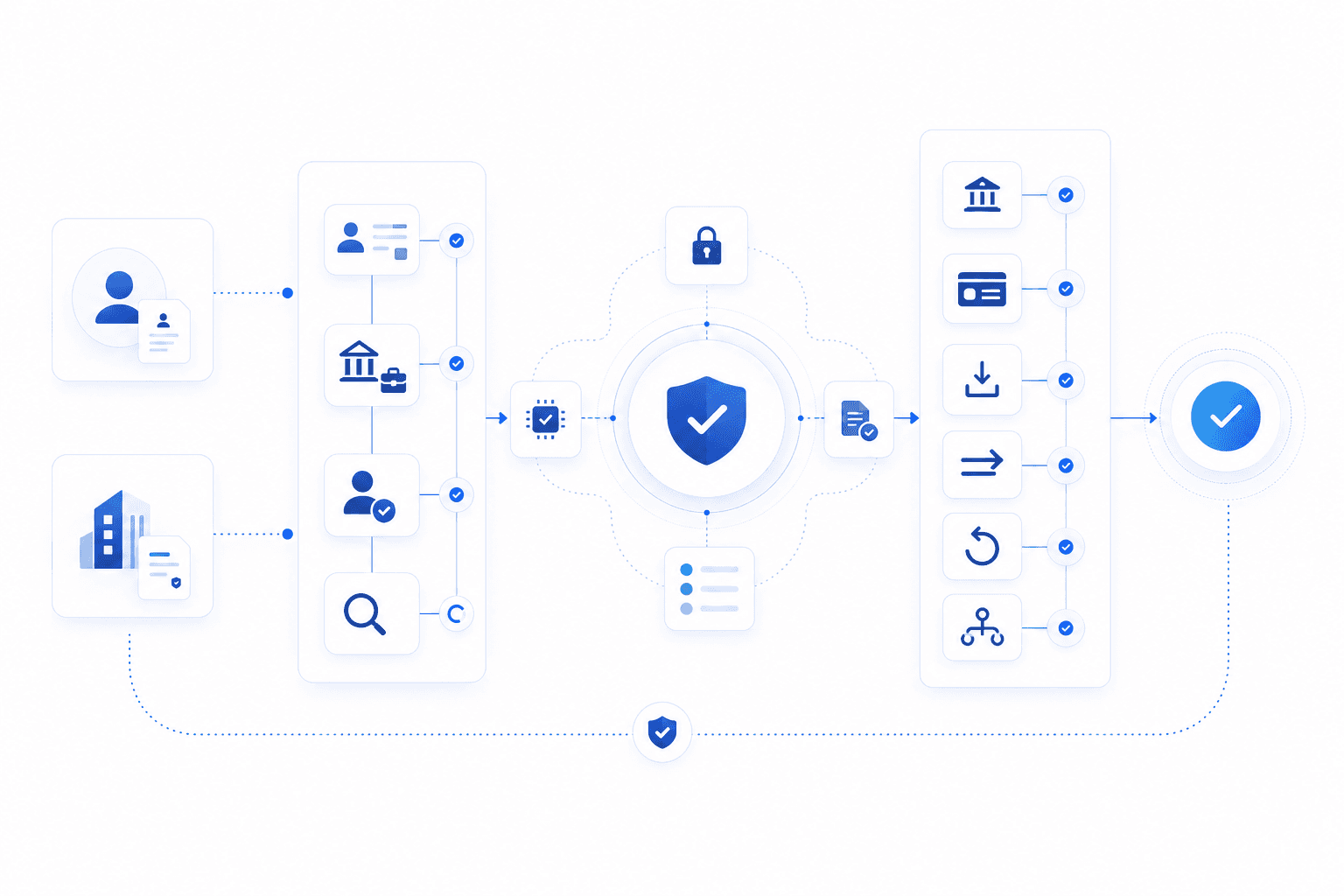
In an embedded finance project, compliance is often perceived as a constraint. It appears at the wrong moment, asks for documents, slows activation and can create a break in the user journey.
For a SaaS platform, marketplace, ERP or fintech, the topic is nevertheless strategic. As soon as a product integrates payments, payment accounts, IBANs, wallets or certain financial flows, it may become necessary to verify the identity of users, companies or beneficial owners.
This is where KYC and KYB come in.
The challenge is simple to state, but difficult to execute: how can compliance requirements be met without degrading the user experience? How can onboarding be secured without reducing conversion? How can necessary checks be integrated without turning onboarding into an administrative tunnel?
The answer comes down to one idea: compliance must not be added after the fact. It must be designed as part of the product.
KYC, for Know Your Customer, refers to the processes used to understand and verify an individual customer. It may involve identifying the person, verifying their identity, understanding the business relationship and, depending on the case, carrying out additional checks.
KYB, for Know Your Business, concerns companies. It aims to understand what the company is, who represents it, who controls it, what its activity is and, where necessary, who its beneficial owners are.
In everyday language, KYC and KYB are often used as operational shorthand. In practice, they cover broader obligations relating to customer knowledge, vigilance, anti-money laundering and counter-terrorist financing, as well as risk supervision.
For a platform, the question is therefore not only: what documents should be requested?
The real question is: at what point, from whom, why, at what risk level, and with what user experience?
Embedded finance consists of integrating financial services into non-banking environments: business software, SaaS platforms, marketplaces, ERPs, invoicing applications, e-commerce platforms or Web3 environments.
As long as the software remains a simple management tool, financial compliance may be limited. But as soon as the platform enables users to collect funds, pay, transfer, store value, assign an IBAN, manage flows or connect digital assets, verification becomes a structuring issue.
Why?
Because financial flows involve responsibilities. It is necessary to know who uses the service, for what purpose, with what amounts, in which country, for what activity and with what level of risk.
For a SaaS provider, this may seem distant from the product. In reality, it is directly linked to the user experience. If too much information is requested too early, the user drops off. If the right information is not requested at the right time, the service cannot be activated properly.
Compliance therefore becomes a product topic, not just a legal topic.
Many journeys fail for a simple reason: compliance is treated as a barrier.
The user discovers the product, starts signing up, then suddenly faces a document request, an identity check, an undefined waiting period or an incomprehensible message. The journey breaks. The platform loses conversion. Support receives questions. The user does not understand why they are blocked.
This approach creates three negative effects.
First, it increases abandonment. A user who does not understand why a document is being requested may decide that the service is too complex.
Second, it undermines trust. Poorly explained compliance feels like an administrative obstacle rather than a security mechanism.
Finally, it slows activation. The product may be technically ready, but unusable until the user has completed the verification journey.
For platforms, the goal is therefore not to remove compliance. It is to integrate it in a fluid, progressive and understandable way.
Effective onboarding does not ask everything from everyone, all at once.
It adapts the level of verification to the use case, the risk, the type of user, the service being activated and the moment in the journey.
This is what can be called progressive compliance.
A user discovering software does not necessarily need to provide immediately all the documents required to activate a financial service. However, when they want to collect funds, open a payment account, receive an IBAN, trigger transfers or access certain sensitive flows, verification may become necessary.
This progressiveness helps preserve conversion.
The user can understand the product, test certain uses, perceive the value, then provide the required elements when activating a financial feature. The compliance request then becomes more legitimate because it is linked to a concrete action.
The right message is not: you must complete a file.
The right message is: to activate this payment feature, we need to verify certain information in order to secure your flows and comply with the applicable framework.
For an individual user, KYC may involve several steps: collecting information, verifying identity, checking consistency, analyzing risk and, where applicable, carrying out additional checks.
To avoid degrading the experience, these steps must be integrated into a clear journey.
This means:
explaining why the information is requested;
limiting fields to what is strictly necessary for the use case;
avoiding repetition;
guiding the user on the expected documents;
clearly indicating the status of the file;
providing simple messages when a document is rejected;
allowing the user to resume the journey without starting over.
The quality of microcopy is essential. Financial onboarding should not feel like an opaque administrative form. It should work like guided support.
The more the user understands what they are doing, the more they accept the effort required.
For B2B SaaS platforms, professional marketplaces, ERPs or service platforms, KYB is often more structuring than KYC.
Verifying a company is more complex than verifying an individual. It requires identifying the company, understanding its activity, confirming its existence, verifying its representatives, analyzing its documents, identifying beneficial owners where required, and sometimes collecting additional elements.
This is precisely where many B2B journeys become heavy.
The user registers on behalf of a company, but does not always know which documents to provide. They may not be the legal representative. They may need to pass the request on to an executive. They may get stuck because they do not understand the role of the beneficial owner. They may abandon the process if the platform asks for too many documents too early.
A good KYB journey must therefore be designed with the reality of companies in mind.
It must distinguish between:
the user creating the account;
the company using the service;
the legal or authorized representative;
the beneficial owners;
the necessary documents;
the access rights within the platform.
In B2B SaaS, this distinction is fundamental. Onboarding must not assume that a single person has all the information.
The concept of beneficial owner can be difficult for a non-specialist user to understand. Yet it is central to many KYB journeys.
In simple terms, the beneficial owner refers to the individual or individuals who directly or indirectly control a company, according to the applicable criteria. The objective is to understand who is actually behind the company.
For a platform, the mistake would be to ask this question without any explanation.
A user may wonder: why am I being asked this when I am registering a company? It should therefore be explained that this information may be necessary for reasons of security, compliance and the fight against abuse of the financial system.
A good journey must make this step understandable without trivializing it.
The explanation must be short, clear and placed at the right moment. The user must understand what is being requested, why it is being requested and what happens next.
A SaaS platform generally sells a promise of simplicity. If financial integration turns that promise into a heavy journey, the impact can be negative.
The objective is therefore not to pile checks into the interface. The objective is to integrate the necessary checks without breaking the product logic.
This means working on several dimensions:
the order of the steps;
the level of information requested at each moment;
the wording used;
the design of statuses;
reminders;
notifications;
support;
error cases;
validation timelines;
the ability to resume the journey.
Good financial onboarding must answer three questions the user implicitly asks:
Why am I being asked this?
How long will it take?
What does this allow me to activate?
If these three answers are clear, the friction becomes more acceptable.
One of the most frustrating aspects of a KYC or KYB journey is uncertainty.
A user who submits documents and does not know whether the file has been received, is under review, is incomplete, has been rejected or has been approved may disengage. They may contact support, abandon the process or lose trust.
Statuses are therefore a major product component.
Ideally, a platform should be able to display simple statuses:
file to be completed;
information received;
verification in progress;
document to be corrected;
validation completed;
feature activated;
additional verification required.
These statuses must be understandable and actionable. It is not enough to display rejected or pending. The user must understand what they need to do.
In SaaS, compliance becomes acceptable when it can be managed.
For platforms, API integration makes it possible to connect the necessary checks without forcing the user to leave the software environment.
The user remains in the SaaS journey. The platform keeps the relationship, interface, business context and usage logic. The specialized component manages the checks, statuses, rules, reminders or technical elements linked to the process.
This logic is central to embedded finance.
The SaaS provider must not become a financial compliance specialist. It must be able to integrate an appropriate component into a coherent journey, with clarified responsibilities.
The benefit is twofold.
For the end user, the experience remains smoother.
For the platform, integration is more controlled, more scalable and better aligned with its product.
Let us be clear: optimizing onboarding does not mean weakening compliance.
Conversion must not come at the expense of security, vigilance or the applicable framework. A platform that integrates financial services must accept that some users cannot be validated, that some files require additional information, or that some use cases must be refused.
The right approach is to reduce unnecessary friction, not necessary requirements.
Useful friction is a step justified by risk, regulation or security.
Unnecessary friction is a step that is poorly placed, poorly explained, redundant or disproportionate.
The difference between the two is decisive.
A KYC/KYB journey must be measured like a product journey.
Relevant indicators may include:
journey start rate;
completion rate;
drop-off rate by step;
average validation time;
number of rejected documents;
main causes of failure;
volume of incomplete files;
return rate after reminder;
number of support tickets related to compliance;
activation rate of the financial feature after validation.
These indicators help identify breakpoints.
For example, if many users abandon the journey at the beneficial owner step, this may indicate a pedagogical issue. If many documents are rejected, the instructions may be insufficient. If validation timelines are poorly understood, statuses should be improved.
Compliance then becomes a product improvement lever.
An invoicing SaaS may want to integrate collection, payment tracking and reconciliation. The user creates an invoice, receives a payment, tracks the status and automatically reconciles the flows.
In this context, certain checks may become necessary when the user activates the collection feature or wants to receive funds.
The right approach is not to request all information when the software account is created. The SaaS can first allow the user to discover the tool, then trigger a verification journey when the financial feature is activated.
The message then becomes natural: to receive payments from your workspace, certain information must be verified.
A marketplace often has to manage buyers, sellers, commissions, refunds and transfers. KYB for sellers or service providers can become a central point.
The challenge is to avoid turning seller registration into an overly heavy journey.
A marketplace can structure onboarding in several stages:
creation of the seller profile;
collection of business information;
prequalification;
KYB trigger when the seller wants to receive payments;
display of statuses;
progressive activation of features.
This approach helps preserve seller acquisition while securing flows at the right moment.
In a vertical ERP or B2B platform, users do not first think finance. They think business: order, service, invoicing, intervention, delivery, subscription.
KYC/KYB must therefore be integrated into the business vocabulary.
Instead of presenting compliance as an abstract step, the platform can link it to a concrete action: activate collections, create an IBAN, receive transfers, trigger payouts, automate reconciliation.
Compliance then becomes understandable because it is attached to immediate value.
TRACTIAL develops financial infrastructure designed to support the integration of payment services and financial functions into software environments.
For SaaS platforms, marketplaces, ERPs and e-commerce platforms, the subject is not only technical. It is about designing a complete journey: activation, verification, statuses, payment, tracking, reconciliation, supervision and reporting.
TRACTIAL can work with platforms to assess use cases in which a KYC/KYB component, combined with payment services, can be integrated coherently into the user journey.
The objective is not to turn every platform into a financial actor. The objective is to enable business software to integrate certain financial functions within an appropriate framework, with a smoother user experience and clarified responsibilities.
The method can be summarized in seven steps.
Identify the financial features actually concerned.
Determine which users must be verified: individuals, companies, representatives, beneficial owners.
Adapt the level of collection to the use case and the risk.
Place checks at the moment they become necessary.
Explain each step in simple language.
Integrate statuses and reminders into the interface.
Measure abandonment, timelines, errors and activations.
This logic makes it possible to build a smoother journey without bypassing the applicable requirements.
KYC, KYB and onboarding must not be designed as obstacles separate from the product. They must be integrated as part of the user journey.
For SaaS platforms, marketplaces, ERPs and e-commerce platforms, the challenge is to find the right balance: enough compliance to secure flows and comply with the applicable framework; enough fluidity to preserve adoption and conversion.
A good journey does not remove the necessary checks. It makes them understandable, progressive and useful.
This is the approach that can turn compliance into a product advantage: less unnecessary friction, more trust, more activation and deeper usage.
Do you run a SaaS, marketplace, ERP or e-commerce platform? Do you want to integrate payments, accounts, IBANs or financial flows without degrading onboarding? TRACTIAL can work with you to assess the scope of a solution adapted to your use cases, constraints and model.
KYC concerns the knowledge and verification of an individual customer. KYB concerns the knowledge and verification of a company, its representatives and, where required, its beneficial owners.
Because integrating payments, accounts, IBANs, wallets or financial flows means knowing who uses the service, for what purpose and with what level of risk.
Avoid asking for too much information too early. The journey must be progressive, contextualized, explained and triggered when the user activates a financial feature.
Often, yes. KYB involves verifying a company, its representatives, its activity and sometimes its beneficial owners. It therefore requires product design adapted to B2B journeys.
Not necessarily. A SaaS provider can rely on specialized infrastructure to integrate the necessary checks into its journey, while maintaining a coherent user experience.
The right moment depends on the use case. In general, it is preferable to request sensitive information when the user wants to activate a financial feature, rather than at the simple product discovery stage.
Useful indicators include completion rate, drop-off rate by step, average validation time, causes of rejection, support tickets, returns after reminders and activation rate after validation.
TRACTIAL can work with SaaS platforms, marketplaces, ERPs and e-commerce platforms to assess use cases in which a KYC/KYB component and payment services can be integrated coherently, subject to eligibility, project scoping and the applicable framework.