Loading article

Since 1 September 2026, all businesses within the scope of the reform have been required to receive electronic invoices. Large companies and mid-sized businesses must also issue them electronically. The transition is well under way, but the available figures point to adoption at different speeds. Above all, being connected to a platform does not necessarily mean that the entire cycle from invoicing to payment and cash management has been transformed.
France's electronic invoicing reform has reached its first operational milestone. For businesses, the question is therefore no longer simply when the reform will apply, but how far they have actually progressed and what they can expect from it.
The latest published studies agree on one point: momentum accelerated sharply as the deadline approached, without eliminating the disparities between large organisations, very small businesses, SMEs and self-employed professionals. They also show that compliance is only the first step. Value creation lies in using structured data to automate operations, secure exchanges and create stronger connections between invoices, payments, reconciliation and cash management.
The most recent figures must be interpreted carefully, as they do not all measure the same thing. Some assess how businesses perceive the reform, while others measure their level of technological readiness or their presence in the electronic invoicing directory. A business may therefore be registered and reachable without having tested all of its processes under real operating conditions.
As of 31 August 2026, 73% of clients receiving bookkeeping services and 74% of clients receiving accounting review services were considered operational by their chartered accountant. The professionals surveyed expected these proportions to rise to 85% and 84%, respectively, by 30 September. This acceleration is significant, but it also confirms the decisive role of professional support.
Looking at a broader scope, the public directory analysed by Connect Compta contained 4.32 million reachable businesses as of 15 September 2026, compared with around one million in mid-June. Connections therefore increased dramatically in the final weeks. Significant disparities nevertheless remain: the published rate is around 66% for large and mid-sized companies, compared with 30.3% for SMEs and very small businesses. The barometer covers entities that do not all fall within the scope of the reform, meaning these rates cannot automatically be treated as a national compliance rate.
The delay cannot be explained by a single rejection of the reform. It reflects a combination of very practical barriers, which are more pronounced among smaller organisations.
The barometer published by the French Institute of Chartered Accountants in September 2026 indicates that 32% of very small businesses and SMEs cite a lack of information about the requirements and procedures as their main barrier. Among self-employed professionals, the Abby study conducted in early 2026 revealed an even clearer gap: 48% cited a lack of information, while 37% still confused a compliant electronic invoice with a simple PDF sent by email.
SMEs, very small businesses and microbusinesses will only be required to issue electronic invoices from 1 September 2027. However, they have been required to receive electronic invoices since 1 September 2026. This distinction between receiving and issuing may have led some businesses to believe, incorrectly, that they still had a full year before needing to take action.
For a small business, the reform competes with immediate commercial and operational priorities. Businesses must understand the scope of the requirements, choose an Approved Platform, confirm compatibility with their existing software, improve the reliability of customer and supplier data, review approval rights and test specific use cases. The Abby study identified lack of time as the second-largest barrier, cited by 37% of self-employed professionals, ahead of complexity and cost.
The 2025 France Num barometer showed that 69% of very small businesses and SMEs already used invoicing software. Yet only 20% issued more than half of their invoices in a structured format that supported automated processing. The real obstacle is therefore not always a lack of tools. It often lies in fragmentation between business software, accounting systems, the Approved Platform, online banking and internal procedures.
An electronic invoice is not a PDF sent by email. It follows an accepted structured or hybrid format and is exchanged through an Approved Platform. This change requires businesses to improve the reliability of their master data, adapt approval workflows and clarify who issues, receives and verifies invoices, as well as who handles exceptions.
An invoice contains structured information about the counterparty, amount, VAT, date and payment due date. When properly integrated, this data can reduce manual re-entry, limit certain errors, improve traceability and make status tracking easier. The benefit nevertheless depends on the level of integration: digitising a document without connecting the systems merely shifts part of the workload instead of removing it.
Electronic invoicing makes exchanges more traceable, but it does not guarantee that a customer will pay on time. The latest Altares study, published on 15 September 2026, shows an improvement in payment behaviour during the first half of the year: 49.7% of French businesses paid their suppliers by the due date, while the average delay fell to 12.3 days, compared with 14.1 days one year earlier. This also means that one in two businesses was still paying late.
The value of the reform therefore lies less in an automatic promise to shorten payment times than in improving a business's ability to act: identifying a blocked invoice earlier, verifying its status, initiating a reminder, preparing a payment and reconciling an incoming or outgoing transaction.
A structured invoice describes what must be paid. It does not execute the payment. As long as invoicing software, the Approved Platform and the financial infrastructure remain separate, users must still switch between environments, re-enter references, check incoming payments and update statuses.
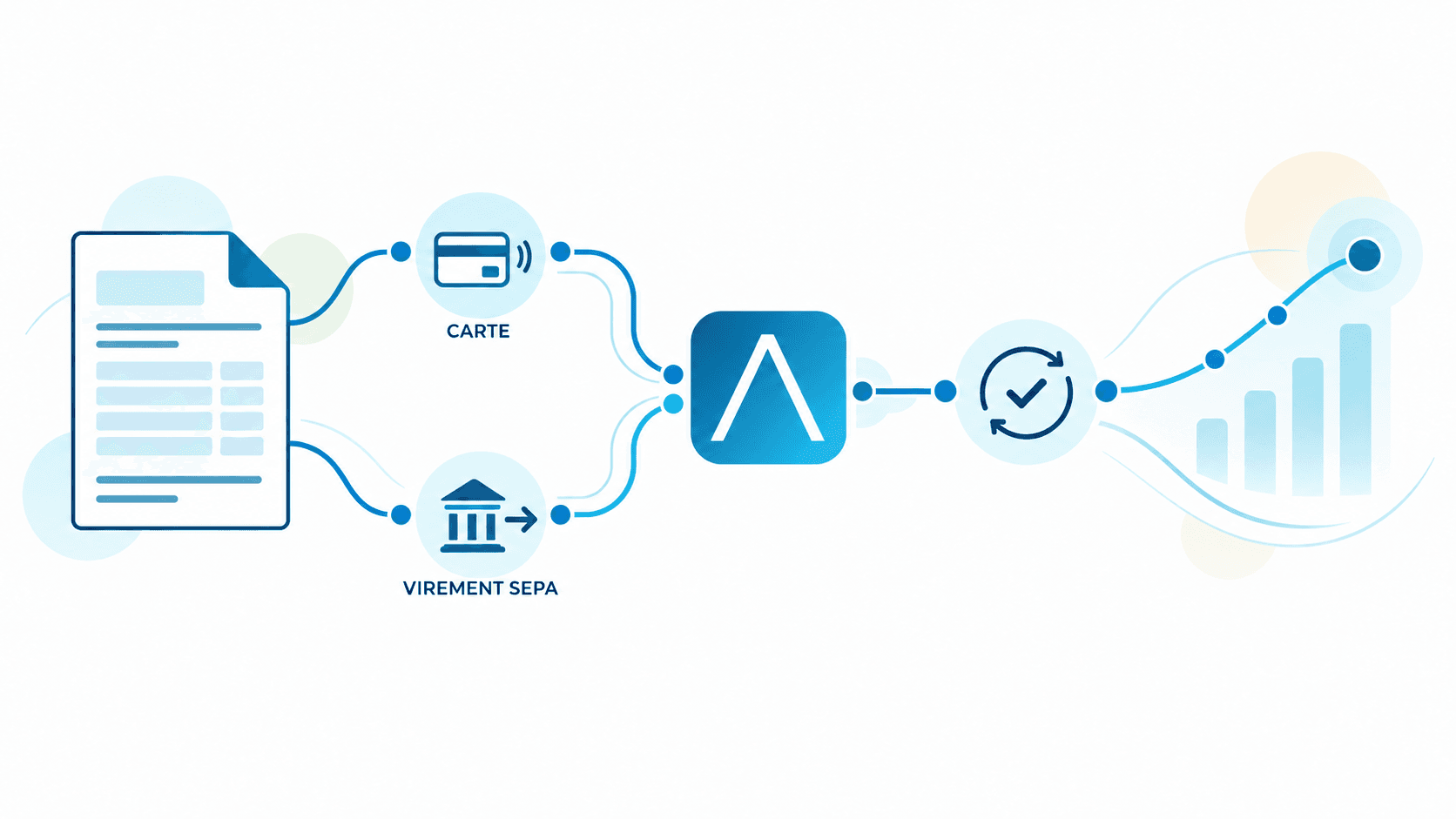
The next stage of the transformation lies at this intersection. By connecting invoice data to the actual movement of funds, a platform can extend the user journey beyond regulatory compliance.
For customer invoices: connect the process to a payment account and an IBAN, identify incoming payments, reconcile transactions and return the collection status to the software.
For supplier invoices: prepare a payment using approved data, apply the required permissions and controls, schedule the transfer for the due date and report its status.
For cash management: reconcile expected due dates with transactions actually executed to improve operational visibility over cash flow.
The benefit does not come from adding a payment button next to the invoice. It comes from a continuous journey: fewer breaks between tools, less manual matching, more reliable statuses and financial data available within the business environment that the company already uses.
Tractial is not an Approved Platform for electronic invoicing and does not assume the platform's regulatory responsibilities. As a Payment Institution authorised and supervised by the ACPR, Tractial provides a complementary layer: financial execution.
Approved Platforms, compatible solutions, ERP providers, invoicing software vendors and cash management platforms can explore integrating payment accounts, IBANs, collections, transfers, payment statuses, reconciliation and financial reporting directly into their own interfaces. Services are connected through the APIs and events available for each project.
The exact model depends on the users, flows, desired level of automation, available data, and the applicable controls and approvals. The objective remains the same: enabling software to go beyond the document and support the financial flow through to execution and reconciliation.
At this stage, electronic invoicing has been adopted widely enough to become an operational reality, but not uniformly enough for the transition to be considered complete. Businesses receiving professional support have moved ahead. Smaller organisations, self-employed professionals and certain sectors remain more exposed to delays, mainly because they lack information, time and clarity regarding the available solutions.
For software providers and platforms, the basis of differentiation will shift quickly. Compliance will remain essential, but it will become a common foundation. Value will come from making the user journey simpler, automating useful tasks and connecting invoices with payments, reconciliation and cash management.
Sources
• French Ministry for the Economy - Everything businesses need to know about electronic invoicing
• French Institute of Chartered Accountants - September 2026 barometer
• Connect Compta by Chift - Position as of 15 September 2026
• France Num - 2025 France Num barometer
• Abby - 2026 electronic invoicing barometer