Loading article

For a SaaS platform, marketplace, ERP or fintech, integrating payment services can become a strategic lever. Collections, payouts, payment accounts, integrated IBANs, status tracking and reconciliation: these functions strengthen product value when they are directly connected to the user journey.
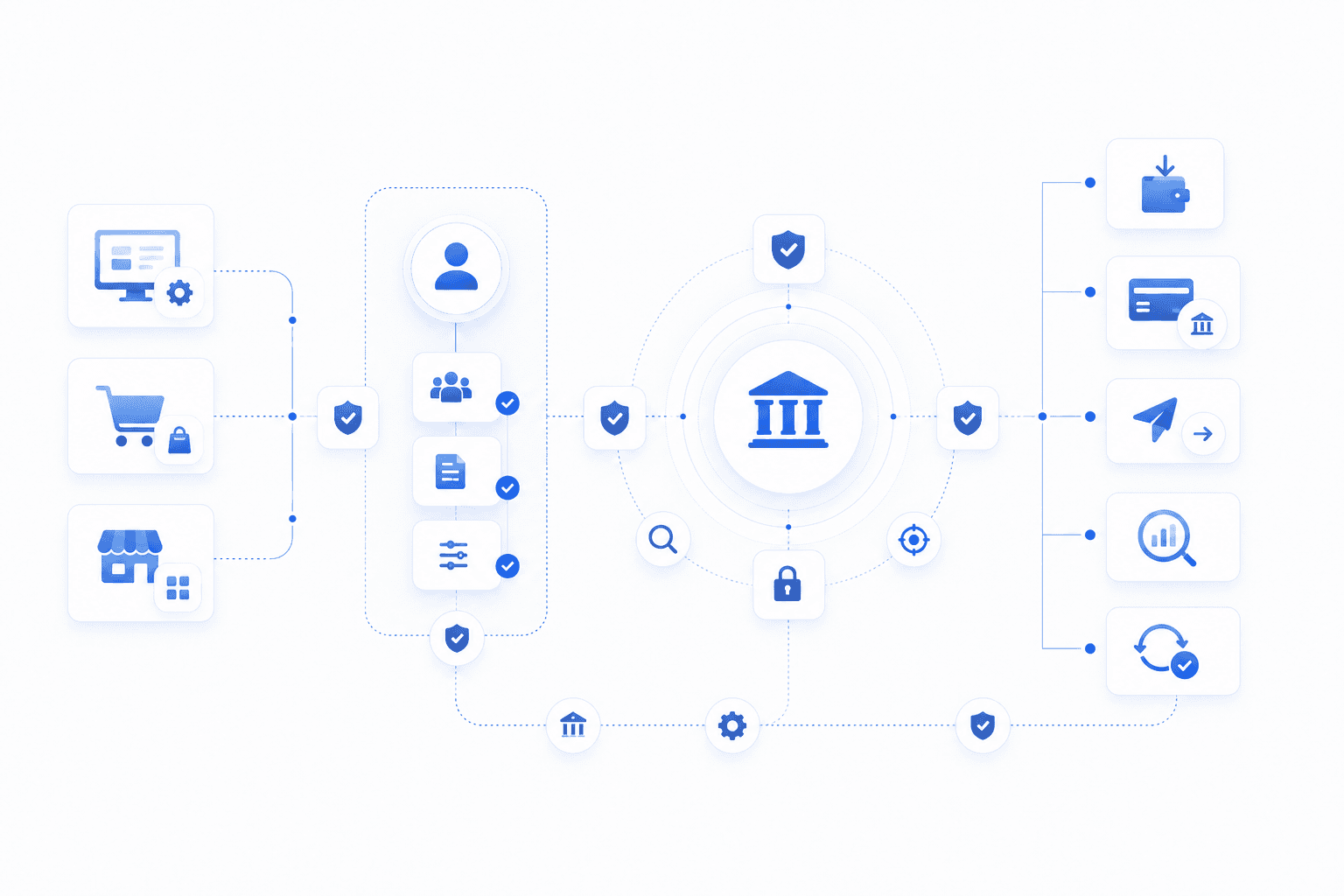
But one question quickly arises: should the platform become a payment institution? Should it obtain its own authorization? Or is there a more progressive model that enables certain services to be operated through a partnership with an already authorized institution?
This is where the agent model of a payment institution comes in.
This status can represent an opportunity for certain platforms, provided they clearly understand what it allows, what it involves and what it does not allow. It is not a simple commercial label. Nor is it a "simplified authorization" that can be used freely. It is an operational and regulatory framework involving a mandate, responsibilities, controls and supervision.
For a SaaS provider or marketplace, the objective is therefore not to "become financial" for its own sake. The objective is to determine whether this model makes it possible to integrate a useful payment component, consistent with the user journey and adapted to the platform's level of maturity.
An agent of a payment institution is an entity that acts on behalf of an authorized payment institution, within a defined scope.
In practice, it may participate in the distribution or operation of certain payment services, according to the terms of the mandate agreed with the payment institution. This mandate specifies the role of each party, the services concerned, operational responsibilities, compliance obligations, control rules, processes to be followed and limits to be respected.
This point is essential: the agent does not itself become a payment institution. It acts within a delegated framework, under the responsibility and supervision of the payment institution with which it works.
For a platform, this can make it possible to integrate certain financial services more quickly than if it had to build the entire regulatory, technical and operational infrastructure on its own. But this acceleration is only possible if the model is properly structured.
Digital platforms are increasingly seeking to integrate financial flows into their user journeys.
An invoicing SaaS may want to allow its customers to collect payments directly from within the tool. A marketplace may want to collect funds, deduct a commission and organize payouts. A B2B services platform may want to track payments linked to services delivered. A vertical ERP may want to connect orders, invoices, payments and reconciliation.
In all these cases, payment is not just an additional module. It becomes a business function.
When financial flows remain outside the software, users have to navigate between several environments: the business tool, a banking interface, accounting exports, reconciliation files and manual reminders. This fragmentation creates friction and reduces the perceived value of the platform.
Conversely, when a payment component is integrated into the experience, the software becomes more central. It enables users to track, collect, reconcile, pay out or automate operations that were previously dispersed.
This is precisely the depth of use that interests SaaS publishers: not making users artificially captive, but making the product more useful, more structuring and harder to replace because it handles a critical operational flow.
Obtaining authorization as a payment institution is a heavy undertaking. It requires significant financial, technical, organizational, human and regulatory resources. It involves appropriate governance, internal controls, security mechanisms, anti-money laundering and counter-terrorist financing procedures, as well as the ability to supervise risks.
Not all platforms are intended to carry this burden on their own.
The agent model can therefore represent an intermediate path. It enables certain platforms to integrate a payment offering through a partnership with an already authorized institution, by relying on its infrastructure and supervisory framework.
For a SaaS platform, this approach can offer several benefits:
reduce time to market;
avoid building the entire regulatory infrastructure alone;
integrate payment services into an existing journey;
test a use case before expanding the scope;
strengthen product value without changing its core business;
gain better control over the user experience;
benefit from a clearer framework for operating sensitive flows.
However, this opportunity must be analyzed with caution. The agent model is relevant only if the flows, responsibilities, users and scope of activity are compatible with this framework.
The agent model of a payment institution is sometimes misunderstood. It should not be presented as a way to bypass regulation.
Being an agent does not mean having free use of an authorization. It does not mean being able to offer any financial service. Nor does it mean that the platform can communicate as a bank, an autonomous payment institution or an independent financial service provider.
The agent acts within a defined scope. It operates on behalf of the payment institution, according to the authorized services, validated procedures and controls in place.
This distinction must be clear in commercial communication, contracts, the user journey and presentation materials.
A platform may be tempted to present this status as a "turnkey solution" or an "integrated payment license". That would be a mistake. The right positioning is more precise: it is a framework that may allow, subject to eligibility and validation, certain payment services to be integrated into a software environment.
This caution does not weaken the commercial message. It makes it more credible.
Becoming an agent of a payment institution entails concrete responsibilities. These vary depending on the model, the services offered, the exact role of the platform and the arrangement established with the payment institution.
Several issues must be analyzed before any launch.
The first question is simple: which services does the platform want to offer?
Is it collection? Payouts? Opening payment accounts? Integrated IBANs? Direct debits? Transfers? Status management? Acquiring payment orders? A financial onboarding journey?
Each service has different implications. General wording should therefore be avoided. A platform does not become an agent "to do payments" in the abstract. It must define precisely the functions it wishes to integrate.
The agent's role must be clear to the end user.
Who offers the service? Who enters into the contract? Who operates the payment? Who holds the funds? Who responds in the event of a problem? What information is displayed in the interface? Which documents are presented to the user?
These elements are not secondary. They determine trust and the compliance of the arrangement.
A sound financial integration must not conceal essential information. It must make the experience smoother while remaining transparent.
Depending on the case, identity or company verification checks may be required. For a B2B platform, KYB is often a central issue: identification of the company, beneficial owners, directors, business activity, country, supporting documents and associated risks.
The agent must know how these checks are triggered, who collects the information, who verifies it, how statuses are managed and how refusals or requests for additional information are handled.
A poorly integrated KYC or KYB journey can harm conversion. Conversely, a well-designed journey can strengthen trust, provided it is progressive, explicit and proportionate.
Financial flows must be monitored, traced and controlled.
A platform that becomes an agent must anticipate payment statuses, errors, exceptions, rejections, suspicions, refunds, payouts and user requests.
Integrating an API is not enough. The day-to-day operation of the service must also be planned.
This is often where the difference emerges between a technical integration and a truly operational infrastructure.
The platform must pay close attention to how it presents the service.
Terms that could create confusion should be avoided: bank, bank account, own authorization, autonomous financial service, implicit guarantee, universal solution. The wording used must match the actual framework.
This requirement is particularly important for listed companies or players exposed to media scrutiny. Imprecise wording can create reputational, regulatory or commercial risk.
The agent model can be very useful, but it has limits.
It is not suitable for every platform. It does not cover all financial services. It does not replace a regulatory analysis. It does not remove the need to put solid internal processes in place. It does not allow services to be promised beyond the authorized scope.
The more a platform wishes to control the entire financial value chain, the more it must question the level of regulatory ambition it is prepared to assume. At a certain stage, some companies may consider obtaining their own authorization. But this requires a much higher level of maturity, resources and governance.
Conversely, for a platform that wants to test a specific use case, integrate a targeted payment component or launch a commercial pilot, the agent model may be a more realistic option.
The right reasoning is therefore not: "should we become an agent or a payment institution?"
The right question is: "what level of financial integration is truly necessary to create user value without carrying disproportionate complexity?"
TRACTIAL can support platforms in analyzing use cases related to integrated payment services.
For a SaaS provider, marketplace, ERP or fintech, the objective is to qualify the right scope: should the platform integrate a simple payment journey? A payment account? An IBAN? A payout mechanism? A reconciliation logic? An agent model? Or a more progressive approach?
This analysis must start from actual flows, not from a status sought in advance.
TRACTIAL can work with platforms to assess:
the nature of financial flows;
the exact role of the platform;
the target user experience;
technical constraints;
KYC or KYB prerequisites;
the respective responsibilities;
pilot scenarios;
success indicators;
the consistency of the model with the applicable framework.
For SaaS publishers and platforms, the value lies in not tackling a complex subject alone. Specialized infrastructure makes it possible to turn a product intention into an integrated financial journey, subject to rigorous scoping.
The agent model can be particularly relevant for SaaS providers that want to strengthen their role in their users' daily operations.
Software that only allows users to create an invoice remains useful.
Software that allows users to create an invoice, track its payment, reconcile the collection, trigger a reminder and produce reporting becomes much more structuring.
This difference is strategic.
The closer a SaaS product gets to the financial flows linked to its users' business, the more central it becomes. This centrality can strengthen retention, reduce churn and increase the perceived value of the product.
But this ambition must remain controlled. Financial integration must serve the use case, not make it more complex. Agent status should not be an objective in itself. It should be a means, when the use case justifies it.
Becoming an agent of a payment institution can represent an opportunity for certain platforms. This model may make it possible to integrate payment services into a SaaS, marketplace, ERP or fintech journey, without immediately carrying all the complexity of obtaining a proprietary authorization.
But this opportunity comes with responsibilities.
The scope must be clear. Roles must be defined. Communication must be precise. Controls must be operational. The user experience must remain transparent. The model must comply with the applicable framework.
For platforms, the right approach is to start from the use case: which flows, which users, which frictions, which value, which responsibilities?
It is on the basis of this analysis that an agent model can be considered.
Do you operate a SaaS platform, marketplace, ERP or fintech platform? Do you want to integrate payment services into your user journey without building the entire regulatory and operational infrastructure alone? TRACTIAL can assess with you the scope of a solution adapted to your use cases, constraints and level of maturity.
An agent of a payment institution acts on behalf of an authorized payment institution, within a scope defined by mandate. It does not itself become a payment institution.
No. The agent model is regulated. The services offered must correspond to the authorized scope, the procedures in place and the framework defined with the payment institution.
The payment institution is the entity authorized to provide payment services. The agent acts on its behalf, within a defined scope, without holding an equivalent proprietary authorization.
A SaaS provider may consider this model if it wants to integrate payment functions into its product: collection, status tracking, reconciliation, payouts or other flows linked to the business journey.
No. It depends on the use case, flows, users, countries concerned, responsibilities and applicable framework. A prior analysis is essential.
The main risks are incorrect qualification of the service, imprecise communication, insufficient governance, a poorly integrated KYC/KYB journey, insufficient flow supervision or an operational scope that is not properly defined.
The first step is to map the financial flows and the user journey: who pays, who collects, who receives the funds, who enters into the contract, which statuses are tracked and which responsibilities must be assumed.
TRACTIAL can assess with platforms the use cases in which an agent model, a payment component or a progressive financial integration could be relevant, subject to eligibility, scoping and compliance with the applicable framework.