Loading article

In embedded finance, one question comes up often: should you integrate a bank account, a payment account, an IBAN or simply a payment function?
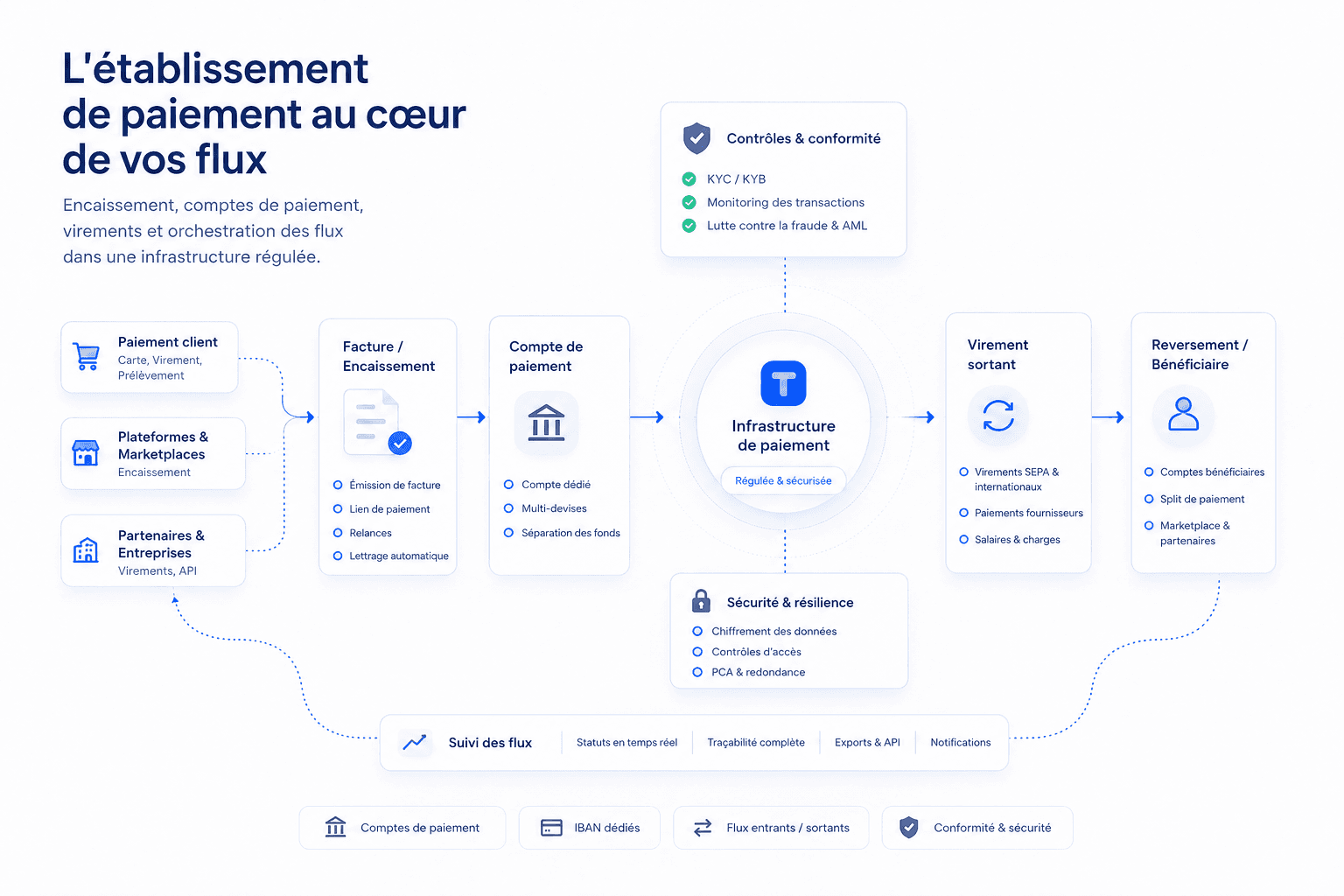
The difference is not just semantic. It has product, regulatory, operational and commercial implications. For a SaaS platform, marketplace, ERP or business software provider, misqualifying the need can make the user experience unnecessarily complex, oversize the project or create a misunderstanding around responsibilities.
Conversely, clearly understanding the difference between a bank account, a payment account and an embedded IBAN makes it possible to design a solution that is simpler, more useful and more consistent with the user journey.
The challenge is clear: integrate the right financial building block in the right place, without turning the SaaS into a bank, without making onboarding heavier, and without forcing users out of the environment they already use every day.
A bank account, often referred to as a deposit account or current account, is opened with a credit institution. It is part of a broader banking relationship.
A payment account is an account opened with a payment service provider, in particular a payment institution or an electronic money institution. It is used to carry out payment operations: receiving funds, paying, transferring, collecting, monitoring flows.
An embedded IBAN is not, on its own, a banking product. It is a European-format account identifier, which can be used in particular to receive or initiate certain payment flows. In a SaaS or platform context, the IBAN can become an experience layer: it makes it possible to link flows to a user, company, customer, invoice or operational sub-account.
The question is therefore not: ‘should a bank be integrated into the software?’
The better question is: ‘which financial function should be integrated into the user journey to reduce friction, automate flows and strengthen the value of the software?’
SaaS platforms have become everyday working environments. They centralise customer data, invoices, orders, subscriptions, services, due dates, statuses and sometimes the entire sales cycle.
Yet in many cases, payment remains separate from the software.
The user creates an invoice in one tool, receives a payment elsewhere, checks the status in a banking interface, exports data, manually matches amounts, then updates the software. This separation creates friction, wasted time and risks of error.
For a SaaS vendor, this also represents a missed opportunity. If payment, settlement status and reconciliation remain outside the product, the software loses part of its operational value. It remains a management tool, but it does not yet become the natural gateway for financial flows.
This is precisely where embedded finance can create value: not by adding a ‘bank’ into the software, but by integrating certain financial functions directly into the business workflow.
The payment account addresses a more targeted logic. It is designed to enable payment operations: collections, transfers, direct debits, card payments depending on the case, transmission of funds, and the management of flows associated with an economic transaction.
Within a platform, a payment account can be useful when financial flows need to be linked to a user, company, customer, seller, invoice or application environment.
For example, a SaaS for freelancers may want to allow its customers to receive payments directly linked to invoices issued in the tool. A marketplace may need to collect funds, calculate a commission, then organise payouts. A business software tool may want to associate an incoming flow with a case, service or order.
In these cases, the payment account can become an orchestration layer. It does not necessarily replace the company’s main bank account. It makes it possible to organise flows linked to a specific use case, within a defined framework.
This is the logic that matters to SaaS companies: integrating a useful financial function, without forcing the user to change banks entirely or move into a parallel experience.
The IBAN is often misunderstood. It should not be confused with the account itself. It is an identifier used to route payments to an account in the European format.
In a SaaS context, the value of an embedded IBAN lies in the fact that it can become part of the user experience. It creates a clear link between a financial flow and a software environment.
In practice, an embedded IBAN can make it possible to:
identify more easily the collections linked to a customer or invoice;
automate the matching between a payment received and a business operation;
reduce input errors or manual reconciliation;
facilitate certain transfer or direct debit flows;
make payment tracking visible in the SaaS interface;
reinforce the use of the software as a central control point.
For the end user, what matters is not the IBAN itself. What matters is what it enables: knowing that an invoice has been paid, that the amount has been received, that the status is up to date, that the reconciliation is automatic, and that the information is available where it is useful.
The IBAN then becomes less of a banking object and more of an experience component.
A SaaS creates value when it becomes essential to its users’ day-to-day operations. The more it centralises critical actions, the harder it becomes to replace.
Integrating financial functions can strengthen this depth of usage.
Take the example of invoicing software. If users create their invoices in the software, then have to leave the tool to check collections, chase customers and reconcile payments, the product remains incomplete. Conversely, if the software allows them to track payment statuses directly, associate flows with each invoice and simplify reconciliation, it becomes much more central.
The same logic applies to a marketplace: if the platform manages the commercial relationship but financial flows are processed elsewhere, it loses part of the operational control. By integrating payment building blocks, it can offer a smoother experience to sellers, service providers or end customers.
For a SaaS, the objective is therefore not to artificially ‘capture’ the user. The objective is to become more useful, more integrated and more structurally important. Retention then comes from real value: fewer manual tasks, fewer errors, greater visibility and more automation.
Education is essential. A payment account should not be presented as a traditional bank account if that is not what it is. There should be no confusion around the services available, responsibilities or guarantees.
A payment account can enable payment operations, but it does not necessarily mean access to credit, overdrafts, savings, banking advice or the full range of services provided by a credit institution.
Similarly, an embedded IBAN does not mean that the platform becomes a bank. It means that a financial building block can be integrated into the user experience, within a given framework.
This clarification matters for three reasons.
First, it protects the end user, who must understand what is being offered.
Second, it protects the platform, which should not promise more than it can actually deliver.
Finally, it protects the business model: a well-understood solution is easier to adopt, integrate and roll out progressively.
Payment accounts and embedded IBANs can be relevant in several environments.
Invoicing software can integrate collection and payment tracking functions. The user creates an invoice, receives a payment, tracks the status and can automate reconciliation.
The value is direct: less manual follow-up, better visibility, more precise reminders and fewer errors.
A marketplace often has to manage several parties: buyers, sellers, service providers, commissions, refunds and payouts. Financial flows are at the core of the model.
An integrated payment infrastructure can help structure these flows, track statuses, organise payouts and provide clearer reporting.
Freelance, intermediation or professional services platforms often need to manage invoices, customer payments, commissions and provider payouts.
The integration of payment accounts or dedicated IBANs can help create a better link between the financial flow and the service delivered.
In an ERP or vertical software environment, payment often occurs after an order, intervention, delivery or service. If it remains separate from the business workflow, teams must reconcile it manually.
By integrating the payment building block, the software can become the natural tracking point for the full cycle: business action, invoicing, payment, status and reporting.
In B2B e-commerce, payment is not limited to checkout. It may include transfers, invoices, due dates, statuses, refunds or flows between multiple entities.
An embedded IBAN or payment account logic can help structure these flows more effectively within the merchant environment.
In many projects, value does not come only from collection. It comes from reconciliation.
Receiving a payment is one thing. Automatically knowing which invoice, customer, seller, subscription or case it corresponds to is another.
This is often where platforms lose time.
Manual reconciliation creates invisible costs: checks, verification, support, reminders, correction, exports and accounting reprocessing. As the platform grows, these costs increase.
A payment account or embedded IBAN can help structure this payment data more effectively. If each flow is linked to a business object, the information becomes more usable.
For a SaaS, this is a major issue: payment should not be merely a financial event. It should become integrated business data.
Some platforms may be tempted to build their own payment infrastructure. In some cases, this can make sense. But for many SaaS vendors, marketplaces or business software providers, this approach quickly raises several questions.
Who carries the regulatory obligations?
Who manages KYC or KYB checks when they are required?
Who supervises the flows?
Who ensures operational security?
Who handles exceptions, statuses, errors or disputes?
Who maintains the technical connections?
Who supports regulatory change?
Embedded finance is not about ignoring these topics. It is about integrating them in a more modular and coherent way, by relying on specialised infrastructure.
For a SaaS, the benefit is to stay focused on its core business while enriching its product with a relevant financial building block.
Integrating a payment account or an IBAN into a platform must always be properly framed. Responsibilities need to be defined: who contracts with the end user, who operates the service, what role the SaaS plays, which data is processed, which verification obligations apply, which flows are authorised, and which countries are concerned.
Not all platforms can activate the same services. The scope depends on the business model, users, flows, amounts, geographies and applicable framework.
This is why an embedded finance project should begin with a qualification phase.
Before discussing technology, the use case must be understood.
Before discussing IBANs, the flows must be understood.
Before discussing payment accounts, the responsibilities must be understood.
This approach avoids misleading promises and makes it possible to build an appropriate solution.
TRACTIAL develops financial infrastructure designed to support the integration of payment services and financial functions into software environments.
For a SaaS, marketplace, ERP or e-commerce platform, the starting point should be the business need: collecting, reconciling, tracking, paying out, identifying and automating.
TRACTIAL can work with platforms to assess the use cases in which a payment building block, payment account or embedded IBAN can improve the user experience and strengthen the value of the product.
The objective is to build a solution that is consistent with:
the existing user journey;
real financial flows;
technical constraints;
regulatory responsibilities;
the platform’s business model;
expected performance indicators.
This approach enables SaaS vendors to avoid carrying financial and regulatory complexity alone, while enriching their product with a building block that delivers strong usage value.
A SaaS becomes strategic when it moves closer to its users’ critical operations. Payment is one of those operations.
When a user can create an invoice, track a collection, reconcile a payment and manage flows from the same environment, the software becomes more than a tool. It becomes an operational gateway.
This is where retention is built.
Not through artificial lock-in, but through real utility. The more the software simplifies essential tasks, the more natural it becomes to use. The more it connects business data and financial flows, the more structurally important it becomes.
For platforms, this is an opportunity: to integrate financial functions in a targeted, measurable and progressive way, in order to strengthen product value and user attachment.
A bank account, or deposit account, is opened with a credit institution. A payment account is opened with a payment service provider and is used to carry out payment operations within a defined framework.
No. A payment account can enable certain payment operations, but it should not be confused with a traditional bank account or presented as such if the service offered does not cover the same functions.
An embedded IBAN can make it possible to receive or identify payments directly linked to a software journey: invoice, customer, seller, subscription, case or transaction. In particular, it facilitates tracking and reconciliation of flows.
No. In many cases, a SaaS can integrate financial functions by relying on specialised and regulated infrastructure, without becoming a banking institution itself.
A marketplace often manages multi-party flows: buyers, sellers, commissions, payouts and refunds. A payment building block can help organise these flows and improve operational visibility.
The first step is to qualify the use case: which flows, which users, which countries, which volumes, which responsibilities, which regulatory constraints and which success indicators.
TRACTIAL can work with SaaS platforms, marketplaces, ERP providers and e-commerce players to assess the use cases in which a payment building block, payment account or embedded IBAN can create operational value, subject to eligibility and project scoping.