Loading article

For a B2B SaaS platform, embedding payments into the product is not just about adding a payment button. It is a way to connect the software more closely to users' critical operations: invoicing, collection, status tracking, reminders, reconciliation and reporting.
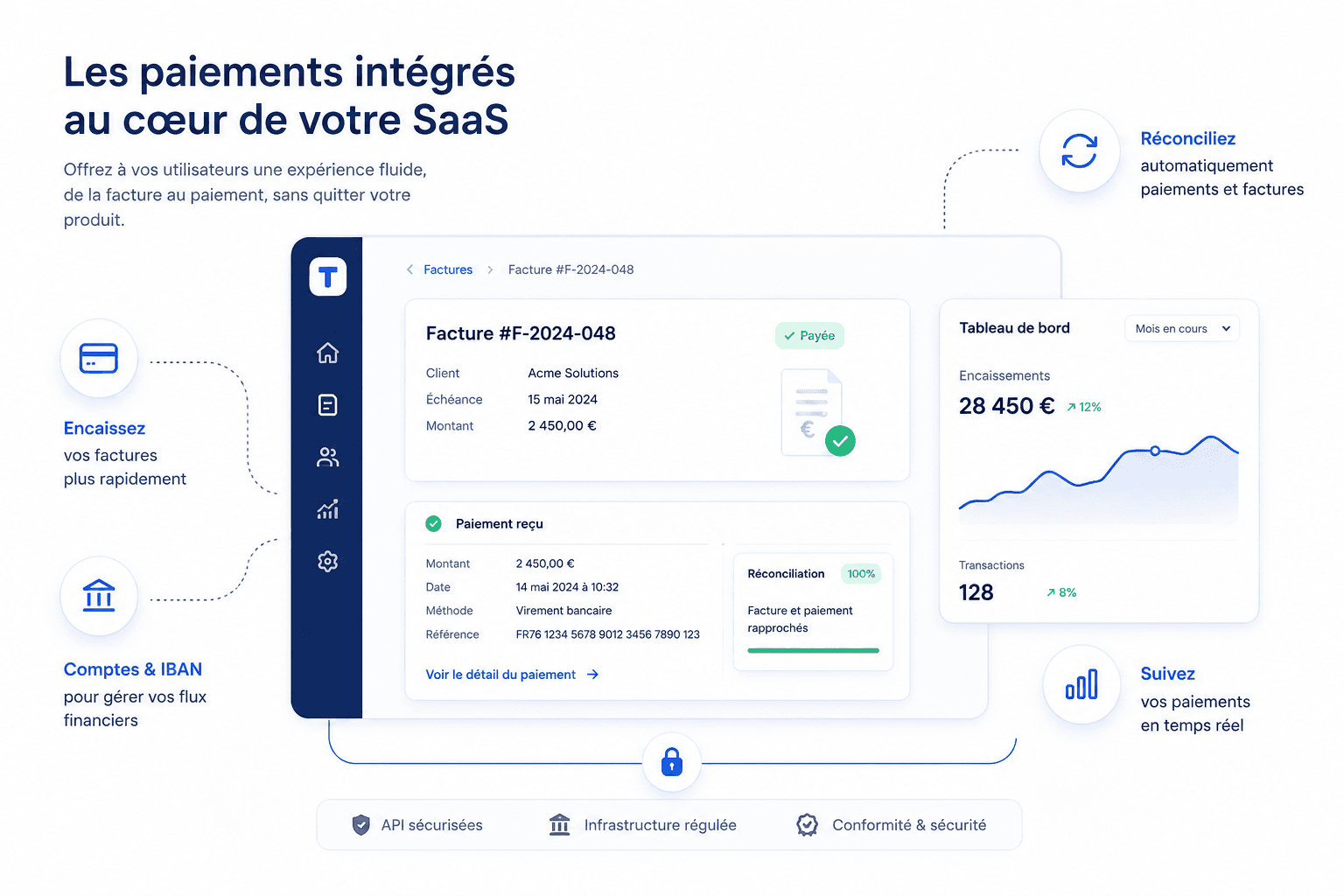
When users have to leave a software environment to pay, collect or check a financial flow, the experience becomes fragmented. The SaaS loses part of the relationship, teams lose time, and financial data becomes harder to use.
Embedded finance addresses this issue by integrating selected financial functions directly into business workflows. For SaaS publishers, the challenge is strategic: strengthen product value, deepen usage and build an experience that is harder to replace because it becomes genuinely useful in day-to-day operations.
Many B2B SaaS platforms now support complete business processes: creating a quote, issuing an invoice, validating a subscription, managing an order, tracking a contract, handling the relationship between a client and a provider, operating a marketplace or automating an operational workflow.
Yet when money starts to move, a break often appears.
The user leaves the software and moves to another environment. The payment is initiated elsewhere. The payment status is tracked in a separate interface. The invoice remains in the SaaS, but the collection is visible in another tool. Reconciliation is sometimes handled manually. Follow-ups rely on exports. Support, finance or operations teams have to check, match and correct information.
This separation creates invisible but costly friction.
It slows users down, weighs on internal teams, reduces data quality and limits the SaaS platform's ability to become the true reference work environment.
For a SaaS publisher, the question therefore becomes central: if your software already carries the business action, why leave the payment outside the experience?
An embedded payment enables a user to manage a financial flow directly from the software they already use.
Depending on the use case, this can include:
collecting an invoice payment;
paying for a subscription;
tracking payment status;
assigning an IBAN or payment account;
automatically reconciling an invoice with a payment;
managing incoming and outgoing payments;
paying out funds to a third party;
collecting KYC or KYB information where required;
embedding financial reporting into the product.
The goal is not to turn every SaaS company into a financial institution. The goal is to enable business software to integrate, in a coherent and controlled way, the financial functions that are useful to its user journey.
In other words, the SaaS keeps the customer relationship, the business logic and the user interface. The specialised financial infrastructure provides the rails, statuses, flow orchestration, necessary controls and integration APIs.
B2B SaaS platforms occupy a unique position: they are already at the heart of their clients' operational processes.
Invoicing software knows the invoices issued, due dates, amounts, clients and late payments.
A vertical ERP knows the orders, services delivered, contracts, interventions and associated flows.
A freelance platform knows the assignment, the client, the provider, the commission, the invoice and the point at which payment should occur.
A subscription management SaaS knows the contract term, renewal, payment incidents and follow-ups.
In all these cases, payment is directly linked to the core service. It is not a secondary function. It is the natural outcome of a business process.
When payment remains external, the SaaS misses an integration opportunity. When it is embedded smoothly, it becomes a logical extension of the product.
This is precisely what makes embedded finance strategic for B2B SaaS publishers.
A SaaS user is not looking to multiply tools. They want to complete a task faster, with fewer errors and greater visibility.
An embedded payment can allow them to:
know whether an invoice has been paid;
trigger a collection from their business tool;
reduce manual follow-ups;
track transaction statuses;
avoid repeated exports;
automatically match a payment with an invoice;
gain a clearer view of their financial flows.
The benefit is simple: the user remains in their work environment.
They do not have to switch between tools to understand what happened. They do not have to manually check whether a payment has arrived. They do not have to rebuild information from separate files.
Finance becomes an invisible building block in the journey.
It does not add complexity. It reduces friction.
For the SaaS publisher, integrating payments can create several structural effects.
The first is a product effect. The software becomes more complete, more useful and closer to the user's operational reality.
The second is a usage effect. The more critical actions a user performs in a SaaS platform, the more central that platform becomes in their daily organisation.
The third is a differentiation effect. Two software products may offer comparable business features; the one that integrates financial flows better can provide a smoother experience that is harder to replace.
The fourth is a data effect. By connecting invoice, payment, status, follow-up and reconciliation, the SaaS improves the quality of the information available to its clients.
Finally, the fifth is a commercial effect. A well-integrated payment building block can help strengthen the SaaS value proposition, provided it addresses a real friction point and is deployed progressively.
This is not about creating artificial dependency. It is about building retention through utility: users stay because the product simplifies an important part of their activity.
In the SaaS economy, value is not limited to features. It also depends on the role the software plays in users' daily work.
A tool that is consulted occasionally is replaceable.
A tool that centralises data, actions, statuses, flows and decisions becomes more structuring.
This is where embedded payments become especially important.
They allow the SaaS to move from a business interface role to an operational platform role. The software is no longer used only to record information. It enables a financial action linked to that information:
an invoice is no longer merely created in the software; it can be tracked, paid, reconciled and integrated into reporting.
an assignment is no longer merely validated on a platform; it can trigger a collection, a commission and a payout.
a subscription is no longer merely managed contractually; it can be linked to a recurring payment, an incident status and an automated follow-up.
This depth of integration creates very tangible value: the SaaS becomes more present, more useful and more embedded in the client's operations.
Not every SaaS platform needs to integrate payments to the same extent. Relevance depends on the business, the user journey, transaction volumes, the nature of the flows and the applicable regulatory framework.
However, some use cases are common.
Invoicing software can integrate collection, payment status tracking and reconciliation with the invoice issued.
The user no longer simply produces an invoice. They know whether it has been paid, when, by which method, and can reduce manual checks.
A business ERP can connect orders, services, invoices and payments.
The closer the ERP is to the business context, the more relevant financial integration can be: B2B services, training, hospitality, construction, logistics, healthcare, rental or recurring services.
These platforms often orchestrate several parties: client, provider, platform, commissions, invoices, incoming payments and payouts.
An embedded payment can help structure collection, tracking, payout and reporting.
Recurring payments, payment incidents, renewals and follow-ups are key topics for SaaS models.
Better integration can reduce breaks in the journey and improve visibility over recurring revenue.
Marketplaces often need to manage more complex financial flows: collection from the buyer, commission, payout to the seller or provider, status tracking and potential refunds.
Embedding payments makes it possible to orchestrate these flows more effectively, subject to the applicable framework.
Adding a payment button is not enough.
A B2B SaaS platform must consider the full financial journey:
who pays?
who collects?
at what point?
which status should be visible?
which data should be sent back into the product?
does a payment account need to be managed?
does an IBAN need to be assigned?
does KYC or KYB information need to be collected?
how should the payment be reconciled with the business object?
how should errors, refunds or exceptions be handled?
which responsibilities belong to the SaaS, and which belong to the financial infrastructure?
These questions are structuring.
They show that embedded payment is not just a front-end feature. It is an infrastructure layer that must be designed with product, engineering, operations, compliance and user experience in mind.
For a B2B SaaS platform, regulation is one of the natural barriers to embedded finance.
This is a legitimate barrier.
As soon as software touches financial flows, responsibilities, obligations, controls, statuses and collected information must be clarified.
But integrating payments does not necessarily mean that the SaaS publisher has to internalise the entire financial infrastructure or become a regulated actor across the whole chain.
A suitable architecture can allow the SaaS to remain focused on its core business while relying on specialised infrastructure for the financial functions that require it.
This is precisely the value of a fintech-as-a-service approach: enabling platforms to connect financial building blocks to their product, with a defined scope, a clear contractual framework and a prior analysis of the use case.
There is no universal right model. It depends on the product, the market, the users, the countries concerned, the flows processed and the desired level of integration.
An embedded payment project does not necessarily need to start with a large-scale rollout.
The right approach is often to start with a pilot.
A pilot makes it possible to test a hypothesis on a limited scope, with precise indicators.
It can focus on a user population, a type of flow, a feature or a client segment.
The objectives are concrete:
verify that the use case is genuinely relevant;
measure adoption;
observe friction points;
validate technical quality;
test the user journey;
track statuses and exceptions;
measure the operational gain;
decide whether the integration should be expanded.
This approach is more prudent, more measurable and more effective.
It helps avoid two common mistakes: integrating a financial building block without a real need, or deploying too broadly before usage has been validated.
A SaaS company that wants to embed payments quickly faces a trade-off: build internally or rely on a specialised partner.
Building internally may seem attractive to retain control. But it involves managing heavy topics: payment rails, compliance, security, monitoring, reporting, maintenance, incidents, regulatory changes and banking or financial integrations.
Relying on a partner can help accelerate execution, frame the scope and keep internal teams focused on the business product.
The right choice depends on the SaaS company's maturity, technical resources, ambition, flow volumes, payment criticality and the level of responsibility it wants to carry.
For many B2B publishers, the challenge is not to become a full financial infrastructure provider. The challenge is to integrate the right building block, in the right place, with the right level of control.
TRACTIAL is developing a financial infrastructure designed to support the integration of payments, financial accounts and related services into software environments.
For a B2B SaaS platform, the process can start with a simple question: where does payment currently create friction in your product?
Based on this question, it is possible to assess:
the existing user journey;
the financial flows concerned;
the data already available in the SaaS;
the breakpoints;
the responsibilities to clarify;
the useful technical building blocks;
the compliance constraints;
the indicators to monitor;
the opportunity for a pilot.
The goal is not to add a financial layer for its own sake. The goal is to design a coherent solution, embedded in the business journey, that can strengthen the value of the SaaS for its users.
Users do not stay because they are locked in. They stay because the product becomes more useful, smoother and more central to their daily work.
This is the logic TRACTIAL can help SaaS publishers structure: turning payments into a usage building block, reducing operational friction and creating an experience that is harder to replace because of its real value.
For B2B SaaS platforms, embedded payments should not be seen as an isolated feature.
They are a product, operational and strategic lever.
They make it possible to connect the business action to the financial flow, reduce friction, improve data quality, automate certain processes and strengthen the role of the software in the user's daily work.
The right integration is not the one that makes finance visible everywhere. It is the one that makes finance useful, discreet and measurable.
For SaaS publishers, the issue is clear: do not leave payment outside the product when it is already a natural part of the business journey.
TRACTIAL can work with SaaS platforms to assess the most relevant use cases, the building blocks that can be activated and the possibility of launching a pilot suited to their environment.
A B2B SaaS platform should embed payments when they are directly linked to its users' business journey. This can reduce friction, improve status tracking, automate reconciliation and strengthen the value of the software.
Embedded finance consists of integrating selected financial functions, such as payments, accounts or reconciliation, directly into business software or a SaaS platform.
Not necessarily. Depending on the use case, a SaaS platform can rely on specialised infrastructure to embed certain financial building blocks into its product. The scope should be assessed according to the flows, users and applicable framework.
The most common use cases involve invoicing software, vertical ERPs, freelance platforms, B2B marketplaces, subscription SaaS platforms and tools that manage invoices, commissions, collections or payouts.
Reconciliation makes it possible to match a payment with an invoice, order, assignment or contract. It reduces manual tasks, improves traceability and provides a more reliable view of financial flows.
The best approach is to identify a precise friction point, frame a use case, launch a pilot, measure adoption indicators and expand gradually if the value is confirmed.
They can contribute to retention if the integration delivers real utility. Retention should not come from an artificial constraint, but from a better experience, time savings and a more central role for the SaaS in daily operations.
TRACTIAL can support SaaS publishers in analysing their flows, identifying relevant use cases and assessing a payment or financial services integration suited to their product, users and applicable framework.